How the testing is organised

The tests fall into two groups. Dead tests come first, on circuits that have been safely isolated. Live tests follow with the supply on, because they need real current and voltage to measure anything.

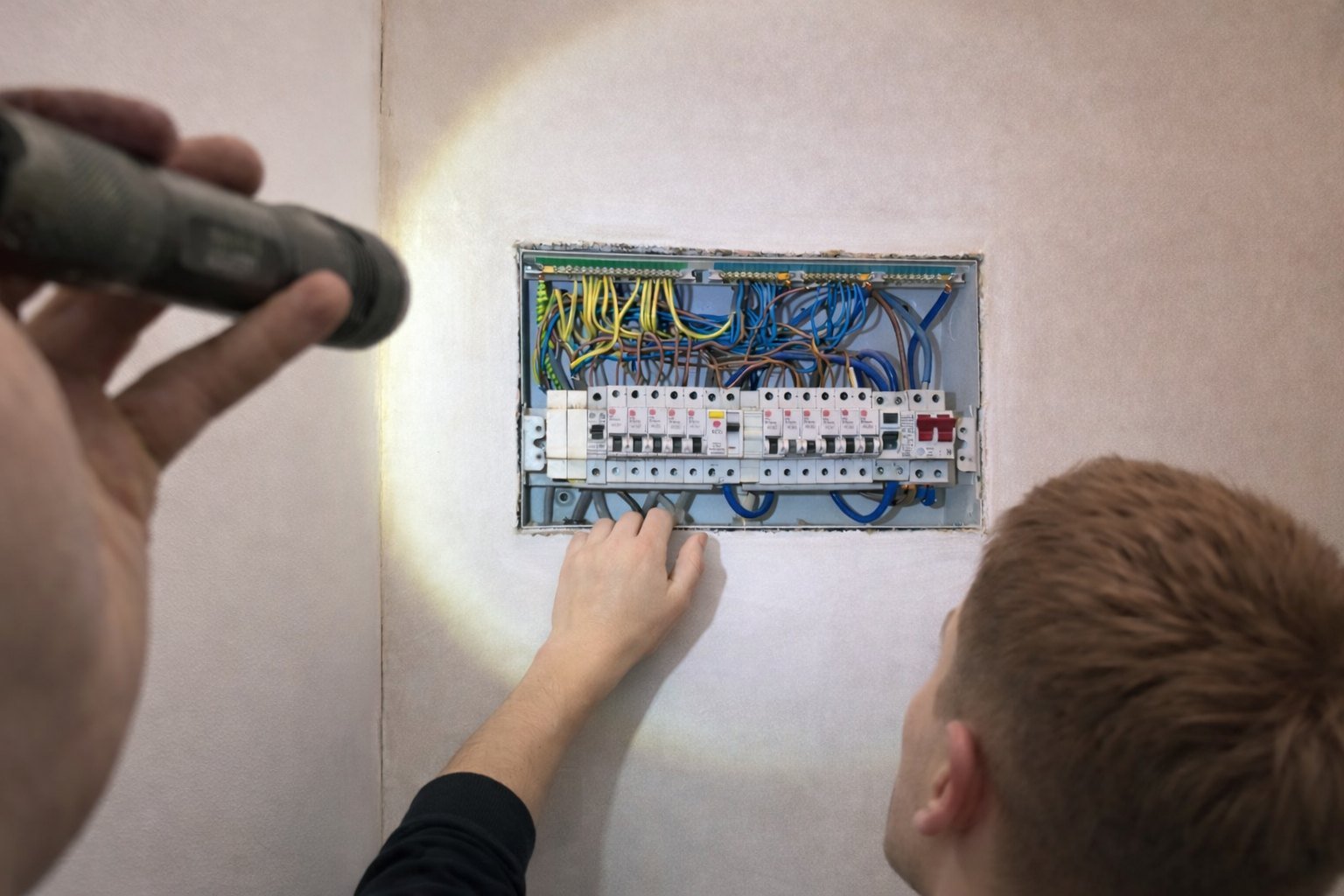
The visit starts with a detailed visual inspection. Much of what ends up coded on an EICR is found by eye: damaged accessories, amateur alterations, missing covers, scorching at connections, cables run where they should not be. The inspection tells us where to look harder when the testing starts.

Next comes safe isolation. Each circuit is switched off and proved dead with a tester before anyone touches a conductor. Power is off one circuit at a time for most of the visit, with short whole-installation shutdowns where tests at the consumer unit require it.

Dead testing then works through the circuits one at a time, followed by live testing once the supply is restored, and finally functional checks on switches, controls and RCD test buttons.

Testing is by sampling to an extent agreed with you before we start, and anything we could not test or access is recorded as a limitation on the report. The final judgement on what the results mean is always the inspector's on the day.
The dead tests

These are carried out on isolated circuits, proved dead before testing begins.

Continuity of protective conductors

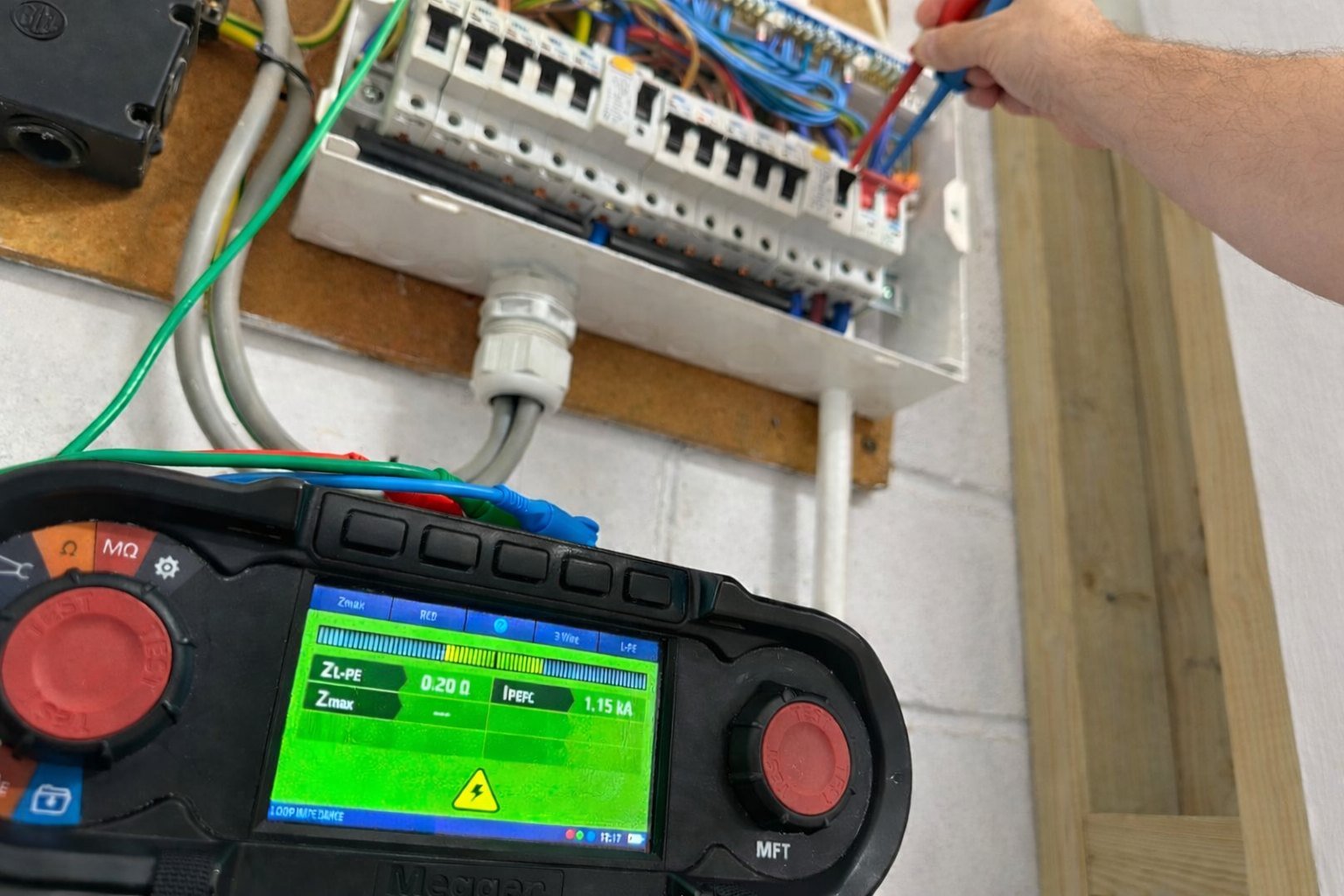
The MFT measures the resistance of the earth conductor from the consumer unit to the points tested on each circuit. A low, consistent reading shows the earth path is intact all the way along. What it proves: the earth path is connected end to end at every point tested, so exposed metalwork is not left without a working earth connection.

Ring final circuit continuity

On ring socket circuits, a three-step measurement confirms both legs of the ring are continuous and correctly connected. A broken ring still works day to day, which is exactly why it needs a measured test. What it proves: a ring circuit really is a complete ring, not a broken one quietly overloading one leg.

Insulation resistance

A raised DC test voltage, typically 500 V DC on most low-voltage circuits, is applied between conductors to check the insulation is not breaking down. Sensitive equipment is unplugged first so the test voltage cannot reach it. What it proves: the insulation on your cables is still doing its job. This is the test that finds ageing and damaged cable before it becomes a fault.

Polarity

Every sampled point is checked to confirm live and neutral are connected the right way round, and that switches and fuses are in the live conductor. What it proves: switching something off actually disconnects the live side, rather than leaving equipment dead but dangerous.

Want this done on your installation?

The full sequence, carried out with calibrated instruments and every reading recorded on your schedules of test results.

Book an EICR

The live tests

These need the supply on, so they are carried out after the dead tests with power restored.

Earth fault loop impedance

The MFT measures how easily fault current can flow around the complete earth loop, from the circuit through the earthing arrangement and back to the supply. The reading is compared against the limits for the protective device on that circuit. What it proves: the earth loop is low enough in impedance for the protective device to disconnect within the required time if a fault to earth occurs.

Prospective fault current

This measures the maximum current a fault at the consumer unit could drive through the installation. The figure is checked against the ratings of your protective devices. What it proves: your fuses or circuit breakers can safely interrupt the worst-case fault, rather than being overwhelmed by it.

RCD testing

Every RCD is trip-tested with the instrument, not just the button. A 30 mA RCD providing additional protection must disconnect well inside the required time limits when tested at its rated current. What it proves: the device that protects you from electric shock actually trips, and trips fast enough.

Functional testing

Switches, interlocks, controls and the test buttons on RCDs are operated to confirm they work as intended. It is the simplest part of the sequence, and it regularly finds problems the measurements cannot. What it proves: the everyday controls of your installation do what they are supposed to when you use them.

What this means for you on the day

  • Power goes off circuit by circuit: Power is off one circuit at a time for most of the visit, with short whole-installation shutdowns where tests at the consumer unit require it. A typical domestic EICR takes around two to four hours.
  • Sensitive equipment is briefly unplugged. Computers, routers, smart devices and similar equipment are disconnected before insulation resistance testing so the raised test voltage cannot damage them. They go straight back on afterwards.
  • We need access to the consumer unit and a sample of accessories. The consumer unit is opened for testing, and a sample of sockets, switches and light fittings is inspected and tested to the extent agreed with you.
  • Every result is written down. The measured values are recorded on the schedules of test results attached to your report, so you have the numbers, not just an opinion.
Two electricians inspecting a distribution board by torchlight
The detailed visual inspection comes first; much of what ends up coded is found by eye before a single test lead is connected

Worried about the power going off?

We isolate one circuit at a time for most of the visit, so a typical domestic EICR runs two to four hours with the house still largely live.

Plan your test day

How the results decide the outcome

Every measured value goes onto the schedules of test results, alongside the limits it was checked against. Anything outside those limits, or anything unsafe found during the inspection, becomes a coded observation on the report.

Those codes are what decide the overall outcome. An installation with no serious observations is reported as satisfactory; one with dangerous or potentially dangerous findings, or anything needing urgent further investigation, is reported as unsatisfactory, with each observation itemised so you can see exactly what needs attention and why.

Book your EICR with EICR Pro. Call 0333 360 8583, answered 24/7, or email info@eicr-pro.co.uk. Quotes are itemised before any work, and we can usually attend within a day, often the same day.

Call 0333 360 8583

General guidance only. What is tested, and what the results mean, is always the inspector's judgement on the day against the current edition of BS 7671 (the wiring regulations).

Leave A Message