Every observation an inspector records on an Electrical Installation Condition Report carries a classification code. The codes, not how many items are listed, decide whether the report comes back satisfactory or unsatisfactory.
An EICR is a working inspection, not a walk round with a clipboard. The electrician opens the consumer unit and a sample of accessories, examines how the installation has actually been put together, then uses test instruments to prove that circuits are continuous, properly insulated, correctly connected, and able to disconnect fast enough when a fault occurs. Everything found is written up, and anything falling short of the current edition of BS 7671 is recorded as an observation with a classification code.
Agreeing the scope and limitations
Before anything is switched off we agree what is being inspected, how much will be opened up and sampled, and anything that cannot be reached or de-energised on the day. That agreement is recorded on the report, so you can see exactly what was and was not covered.
Checking the existing paperwork
Any previous certificates, records of alterations and details of the earthing arrangement tell us what to look for, and where the installation is most likely to have been extended or altered.
The detailed visual inspection
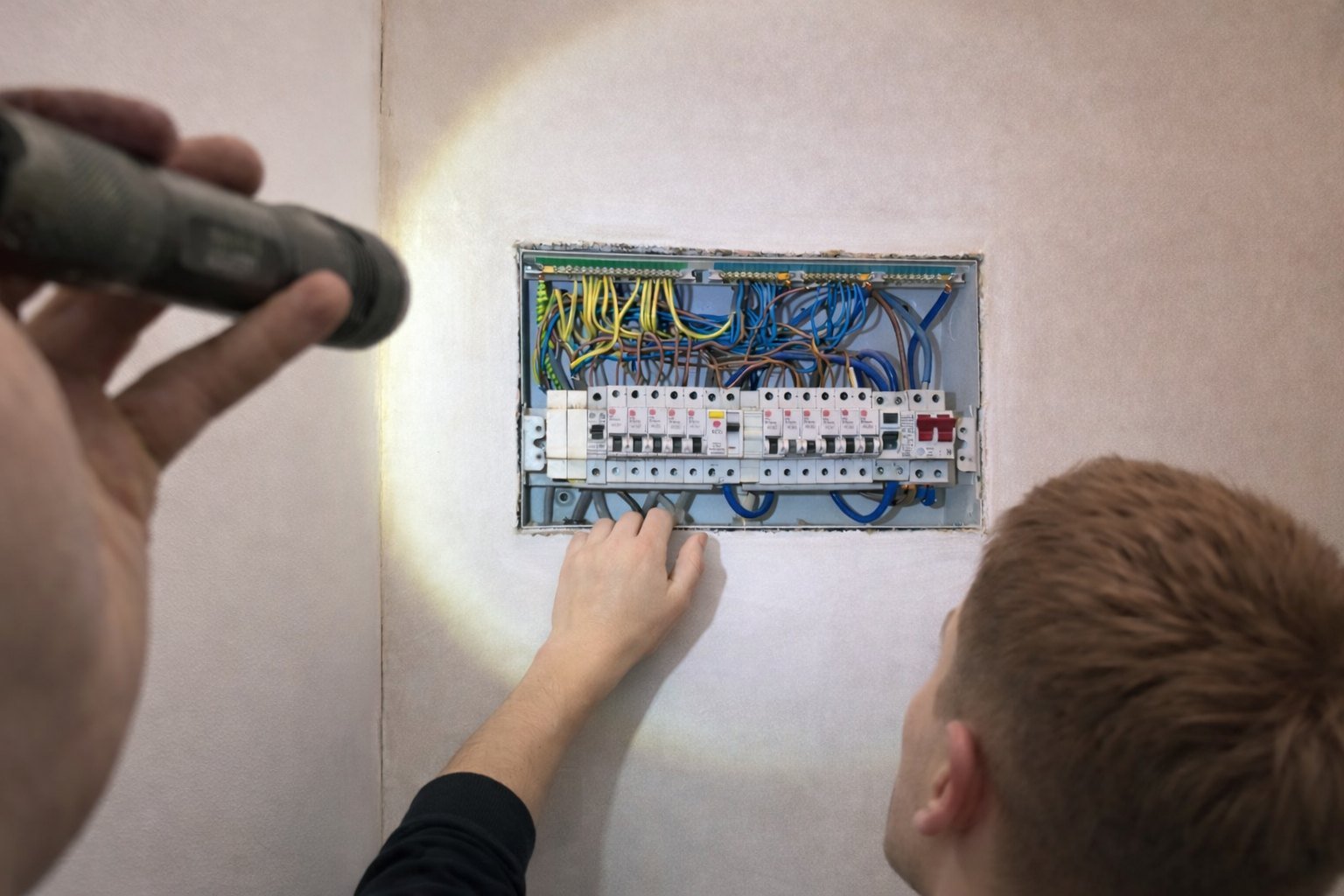
The board is opened and covers come off a sample of sockets, switches and accessories. We look at cable types and sizes, connections, protective devices, earthing and bonding, damage, deterioration, overheating and unsuitable DIY work. A large share of what ends up coded is found by eye at this stage, before a single test.
Safe isolation
Nothing is tested dead until it has been proved dead. The circuit is switched off and locked off, a warning notice applied, and an approved voltage indicator is checked on a known live source, used on the circuit, then checked again to prove it was still working.
The dead tests
With the circuit isolated we measure continuity of the protective conductors from the board to the far end, prove that ring final circuits really are complete rings rather than broken ones, test insulation resistance to confirm nothing is leaking where it should not, and confirm polarity: that the live conductor lands where it should through fuses, switches and lampholders.
The live tests
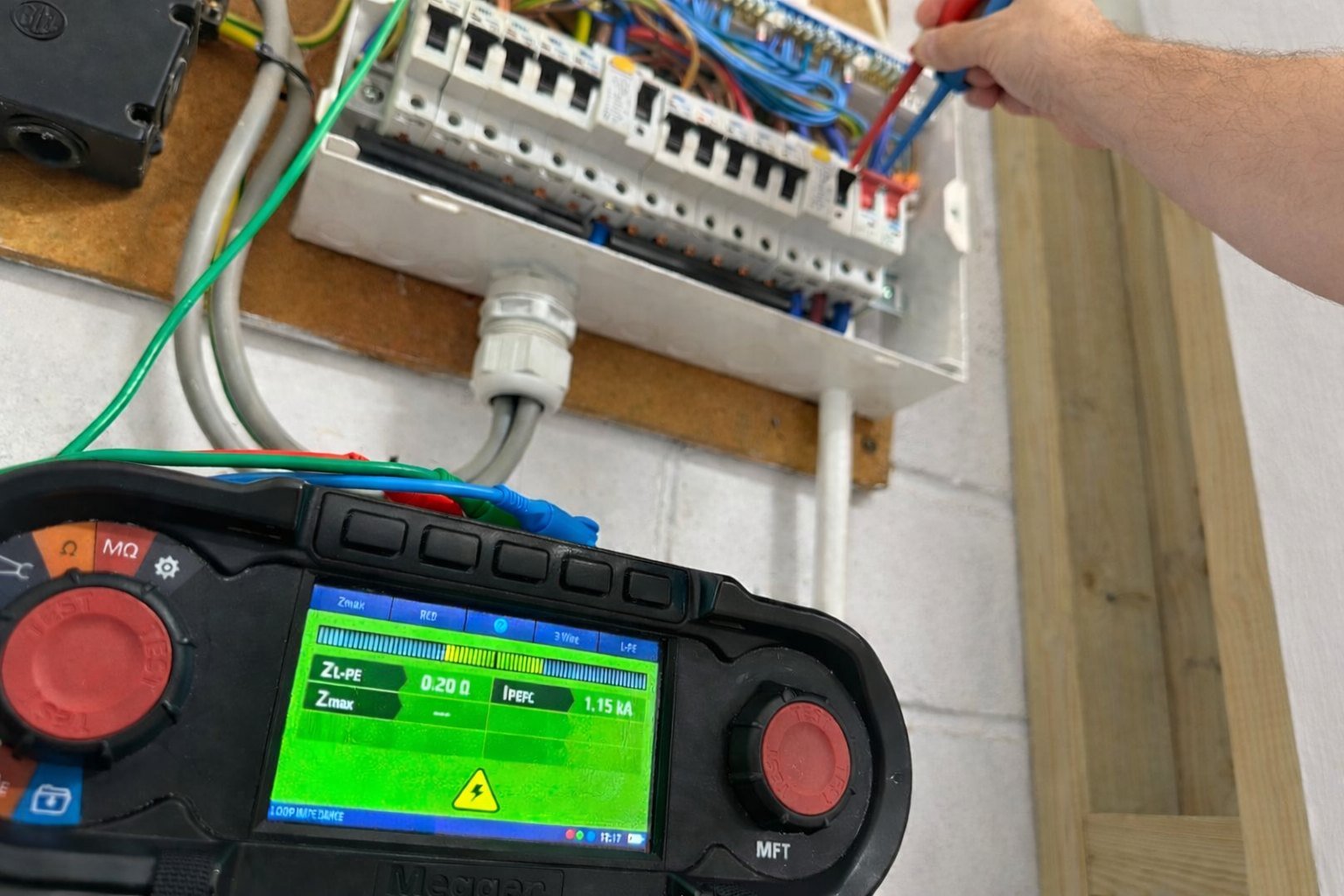
Only once the dead tests are complete is the supply restored. We measure earth fault loop impedance to prove the protective device will disconnect quickly enough, measure prospective fault current to confirm those devices can safely interrupt a fault, and test every RCD and RCBO with an instrument that injects a controlled fault current and records how fast it trips.
Functional testing
Main switches, isolators and switchgear are operated to confirm they do what they should, and we check that labelling and circuit identification actually match what is installed.
Recording the results
Readings are written down circuit by circuit as we go, on the schedule of test results, alongside a schedule of inspections covering everything examined visually. Together these are the evidence behind the report, rather than an opinion offered after the event.
Coding, and talking you through it
Each defect or departure is written as an observation and given a classification code. Before we leave we explain what was found, what it means for the property and what putting it right would involve. Anything presenting immediate danger is made safe there and then, with your agreement, and recorded as having been made safe.
What to expect on the day
The power goes off, circuit by circuit. Half the tests can only be done dead, and they have to be done before that circuit is re-energised. We work through the board one circuit at a time, so most of the property keeps power for most of the day, with a full shutdown only for work at the board itself.
Allow three to four hours for a straightforward two or three bedroom house. Older properties, installations that have been extended, and boards with a lot of circuits take longer.
Inspection is by sampling, to an extent agreed with you beforehand. We do not remove every socket in the building; we examine a representative proportion, and extend that sample if it turns up defects. Whatever could not be inspected is recorded on the report as a limitation, so nothing is quietly glossed over.
We need access to the consumer unit and meter, so please clear anything stored in front of them, along with access to a sample of sockets, switches and light fittings, and to lofts and under-stairs cupboards where cabling and junction boxes usually live.
Tell us about anything sensitive before we start (computers and tills, freezers, alarms, care or medical equipment, or boilers with fussy controls) so we can plan around a loss of supply.
Readings are taken circuit by circuit and recorded on the schedule of test results, the evidence behind every code on the report
Want the inspection, not just the codes?
Allow three to four hours for a typical two or three bedroom house; a three bedroom EICR is £250, itemised and agreed before we start.
At the end of the visit the electrician issues an Electrical Installation Condition Report. It is worth being clear about what that document is: it is not a certificate for work carried out, and it is not a receipt for the visit. It is a formal record of the condition of an existing installation, drawn up on the model report form set out in BS 7671 and signed by the person who did the work.
Its most-read part is the list of observations: the things found to fall short. Each one is written in plain terms and given a classification code: C1, C2, C3 or FI. Those codes are the subject of this page, and they are what decide the report's overall outcome.
That outcome is a single declaration: satisfactory or unsatisfactory. There is no score, no percentage and no partial grade. It is decided by the codes recorded, not by how many observations there are: a report listing eight C3 items and nothing else is satisfactory, while a report listing one C2 and nothing else is not.
A report describes the installation as it was found on the day, within the extent agreed and subject to the limitations recorded on it. It is a condition assessment, not a guarantee that nothing will go wrong afterwards, which is why it also carries a recommended date for the next inspection.
Already holding a report full of codes?
Send it over and we will talk you through every observation on it in plain English, then price only what actually needs doing.
Risk of injury is immediate. Exposed live parts, a broken accessory with conductors showing, or a circuit that could give someone a shock today.
What happens: we make it safe on the spot with your permission before we leave, and the report records both the danger and the action taken.
Makes the report unsatisfactory
C2
Potentially dangerous
Not presenting immediate danger at the time of inspection, but one further foreseeable event (an earth fault, contact with metalwork, water getting in) would make it so.
What happens: urgent remedial action is required; a C2 is not an advisory. This is the most common reason a report comes back unsatisfactory.
Makes the report unsatisfactory
FI
Further investigation
Something was found that could not be resolved on the day and needs looking into before anyone can judge how serious it is.
What happens: investigation without delay. Until it is resolved the report cannot be satisfactory.
Makes the report unsatisfactory
C3
Improvement recommended
Safe as it stands, and the only code that does not make a report unsatisfactory. Something that would not be installed this way under today’s standard but was acceptable when it was fitted.
What happens: nothing has to be done. Act on it at your own pace, or fold it into planned work.
Never makes a report unsatisfactory
A report is recorded as unsatisfactory if anything is coded C1, C2 or FI. C3 items on their own never make a report unsatisfactory. A landlord's certificate is only accepted once the C1, C2 and FI items have been cleared.
What Kind of Issue Falls Under Each Code
Read this first: the codes are a judgement, not a lookup table. Every code is decided by the inspector, on your installation, on the day, with the test results in front of them. The same words written on two reports can properly carry different codes in two different properties, because the code depends on where the defect is, who uses the building, what else was found and what the testing showed. Guidance such as IET Guidance Note 3 and the Electrical Safety First Best Practice Guide 4 gives inspectors a shared vocabulary and suggested classifications; it does not decide the code for them, and neither does this page. What follows is the kind of finding that would normally lead an inspector one way or the other, not a determination about your property.
What is not a matter of judgement is the consequence: any C1, C2 or FI makes the report unsatisfactory, and C3 items on their own never do.
C1
Danger present: the report is unsatisfactory
The question is whether someone could be hurt as the installation stands, with no further fault needing to occur first.
If you think you have any of these, switch off at the main switch and call an electrician. Do not open the accessory to check.
Live parts that can be touched
A socket or switch with a broken faceplate leaving a terminal reachable behind it
A missing blanking piece in the consumer unit leaving live parts reachable
Bare conductor ends left where a person can reach them with the circuit still live
Damaged cable with bare copper showing in an accessible position
Metalwork or fittings left live
A switch wired into the neutral rather than the line, so a lampholder stays live with the switch off
Exposed metalwork found to be live when tested
Protection deliberately defeated
A fuse carrier bridged with a nail, a bolt or a length of wire
A protective device bypassed or strapped out
Water reaching live parts
Water standing inside an energised enclosure that is within reach
Where the line sits. The boundary with C2 is whether danger exists now, not who happens to be nearby. Restricted access does not turn a C1 into a C2: if live parts are accessible, the danger is present. An RCD that does not operate when tested, where it is the only means of fault protection, sits at this end too.
C2
Potentially dangerous: the report is unsatisfactory
Not presenting immediate danger at the time of inspection, but a layer of protection is missing or has failed, so one further foreseeable event would make it dangerous. Urgent remedial action is required.
Earthing and bonding missing or inadequate
A circuit with no protective conductor: no earth available anywhere on it
Main protective bonding to the incoming gas or water services missing, or undersized
An earthing conductor too small for the supply arrangement
Protection that cannot be shown to work
Earth fault loop impedance measured above the maximum permitted for the protective device, so the circuit cannot be shown to disconnect in time
An RCD that trips, but not within the required time
Insulation resistance below the minimum value given in the current edition
Missing RCD protection where it matters
Circuits serving a room containing a bath or shower
Cables concealed in walls at shallow depth without earthed containment or other protection
Socket-outlets that could reasonably be expected to supply equipment used outdoors; in most houses, at least one socket meets that description
Deterioration, without exposed live parts
Old rubber-insulated cable gone hard and cracking when disturbed, but with the conductors still covered
Signs of arcing or overheating at a termination
An accessory not securely fixed, so the plate can be pulled away from the box
Where the line sits. Each of these is the usual outcome, not an automatic one. The same deterioration reaches C1 once a live part becomes touchable: hardened cable is C2 while the copper stays covered, and C1 once it does not. Absence of RCD protection is the most argued-over item on any report: the code turns on what is unprotected, so general-purpose socket-outlets in an older, unaltered installation are often treated as C3, while the three cases above are normally treated more seriously.
Seen a C1 or C2 on your own report?
These are the two codes that make a report unsatisfactory, and the ones with a deadline attached for landlords. Read us the observation and we will tell you what clearing it involves.
Further investigation: the report is unsatisfactory
Not a severity rating. The inspection produced real evidence that something may be wrong, but within the agreed extent the inspector could not establish what it is or how serious, so it must be resolved before the installation can be judged.
Readings that do not add up
A result well out of line with the rest of the installation where nothing visible explains it, and where the value is still inside the permitted limit
Something that cannot be traced
A bonding or earthing conductor that disappears into sealed construction and cannot be verified
Alterations that clearly continue beyond what can be reached
The hidden extent of visible damage
Where damage can be seen it is coded on what can be seen: scorching at a socket would normally attract a C2 in its own right, or C1 where live parts are exposed. It is the part that cannot be followed back that drives the further investigation
Where the line sits. A reading outside the permitted limit is a demonstrated departure and is coded on its own merits (usually C2) rather than deferred to an investigation. FI is for the genuine unknown. It cuts both ways: because the seriousness is precisely what has not been established, an investigation can end up finding nothing at all, or something that turns out to be a C1. Worth asking on the day: has anything been isolated meanwhile, and is the investigation chargeable?
C3
Improvement recommended: the only code that does not make a report unsatisfactory
Safe as it stands, and presenting no risk of injury, but the installation would be better if it were improved. Typically something that was acceptable when it was installed and would not be done that way now.
Older but sound arrangements
General-purpose socket-outlets without RCD protection in an older, unaltered installation, subject to the outdoor-equipment point above
Protective measures that were not required at the time the installation was put in
Physical condition, nothing exposed
A faceplate sitting slightly proud of a shallow box, both screws in and the plate closed
Surface damage or discolouration that leaves no live part reachable
Labelling and records
No circuit chart at the board, or labels that no longer match the circuits
Missing warning or periodic-inspection notices
Improvements the current edition would now expect
No surge protective device where one would now be considered
Arrangements that meet an older standard but not the way it would be designed today
Where the line sits. C3 items never make a report unsatisfactory, and the landlord duty to arrange remedial work attaches to C1, C2 and FI items, not to C3. That is not the same as saying a C3 should be ignored; it is a recommendation from someone who has just examined your installation, and folding them into planned work is usually the cheapest time to deal with them. Two items sit closer to the line than people expect: a damaged accessory is only C3 while every terminal stays enclosed, and an old rewireable fuseboard is not automatically C3; it depends on whether a live part is accessible when a fuse carrier is withdrawn, and on whether the circuits can be shown to disconnect in time.
Unsure a code was applied fairly?
Coding is a judgement made on the day, so if a C1 or C2 on your report does not add up, send it to us for a second read.
People often assume a long list of observations means a failed inspection. It does not. A report with a dozen C3 items and nothing else is satisfactory: the installation is safe to stay in service. A report with a single C2 is unsatisfactory, however short it is.
That is why the codes matter more than the count, and why it is worth reading which code sits next to each observation before worrying about the length of the list.
If your report is unsatisfactory, it is not a condemnation of the property. It is a list of specific, fixable items, and once they are cleared you get written confirmation that the installation now meets the required standard.
Unsatisfactory because of a C1 or C2?
The 28 day clock starts at the inspection. We quote against each observation, clear it, and issue the written confirmation your tenants and the council need.
Act within 28 days: where a report requires remedial or further investigative work, it must be completed within 28 days, or sooner if the report specifies a shorter period
Get it in writing: obtain written confirmation from the electrician that the work is done and the installation now meets the standard
Supply the paperwork: give a copy of that confirmation, along with the original report, to the tenants and to the local authority within 28 days of the work being completed
C3 items are not a duty: improvements recommended under C3 do not have to be carried out to satisfy the regulations
Keep the cycle: the next inspection is due at least every five years, or sooner if the report sets a shorter interval
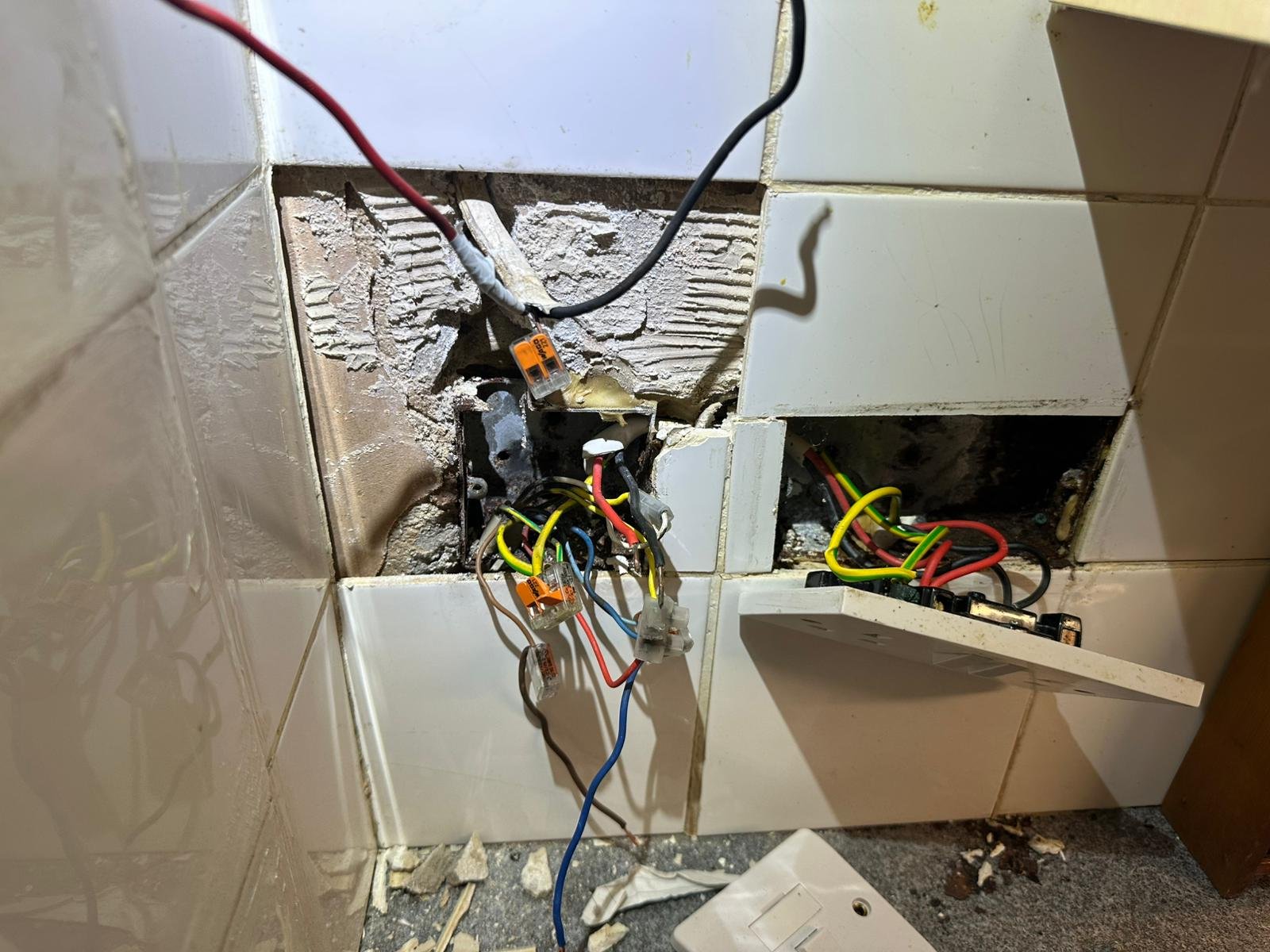
The kind of finding that gets written up as an observation; what it is coded depends on whether a live part can be reached
General guidance only, not legal advice. Confirm your own duties with your local authority.
Not sure what a code on your report means, or what it will take to clear it? Send us the report and we will tell you plainly what needs doing, and quote for it before we start.